
Choosing the Right Cold Drink Cup for Your Business begins with the moment a customer picks up a drink. A thin cup may soften under melting ice. A lid may leak when a delivery driver turns a corner. These small failures can affect customer trust, even when the drink itself is excellent.
Sustainable-design expert William McDonough offers a useful principle: “Design is the first signal of human intention.” For a Cold Drink Cup, that means looking beyond appearance. Consider the drink, serving temperature, cup size, lid fit, storage space, and disposal options. A café serving iced lattes may need a sturdy cup that shows the drink clearly. A busy juice bar may value reliable lids and easy stacking more. There is no single best choice.
Compare samples with the actual drinks you serve. Fill them with ice, test the lids, and leave them on the counter for several minutes. Check whether the cup feels comfortable to hold and whether staff can stack it quickly during a rush. Then review material claims and supplier specifications rather than relying on vague labels. This takes time. It can also reveal that your first-choice cup is not the right one. A practical buying decision balances customer experience, operating needs, and realistic sustainability goals.
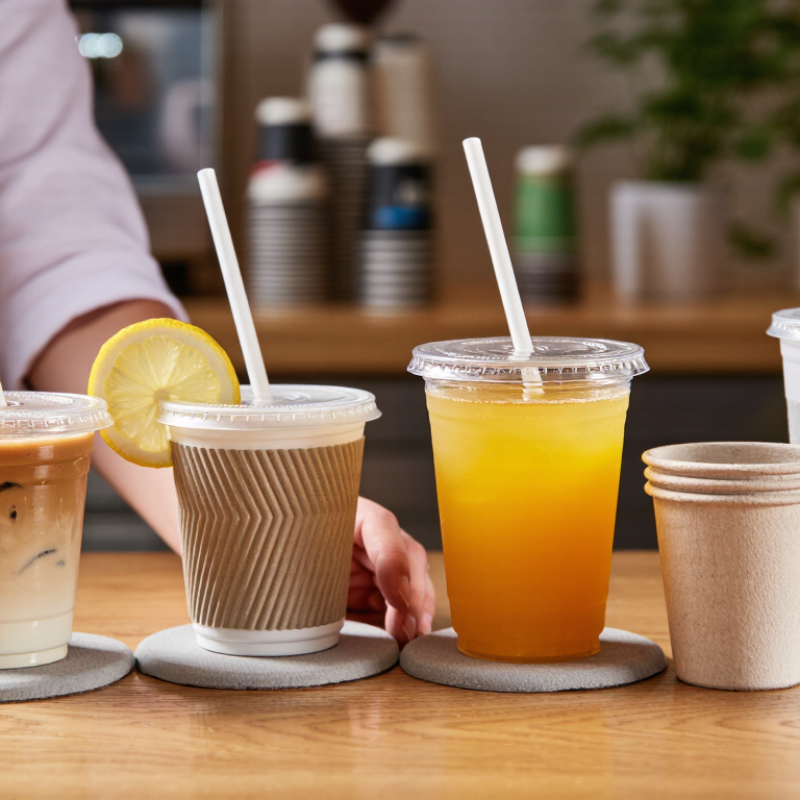
Choosing the right cold drink cup starts with the recipe and serving size, not the cup rack. A 12 oz format can suit a compact juice, while a 16 oz cup often leaves room for ice in iced tea or soda. Ice changes everything. A cup’s stated capacity usually describes its brim-full volume, not the amount of drink customers receive. For an accurate portion, test the actual pour with the usual ice level. Measure before ordering.
For smoothies, lemonades, and layered drinks, 20 or 24 oz cups provide more space for toppings and wider straws. Larger is not always better; extra headroom can make a modest serving look sparse and increase material use. Check that the selected lid fits securely and that its opening works with the straw or sipping style. During a busy shift, staff should be able to fill cups consistently without estimating by eye. Try several sample sizes with real recipes before committing to a case. I still find that ice shape can change the usable space more than expected, so a quick counter test is worth repeating when recipes or ice supply change.

Choosing a cold drink cup involves more than comparing thickness or price. The FDA’s food-contact rules in 21 CFR depend on the cup’s materials and how it will be used. Plastic cups, paperboard cups with polymer linings, and printed or coated surfaces may involve different requirements. Some relevant provisions appear in 21 CFR Parts 175–178, while plastics are addressed in Part 177. The exact rules depend on the material and its intended use.
Check documentation for the finished cup, not just a raw-material description. Ask whether the cup is suitable for the drinks you serve and the expected contact conditions. A cup used for iced water may face different conditions from one holding acidic juice for several hours. Details matter.
FDA compliance is not established by the phrase “food grade” alone, and it does not mean every cup has received FDA approval. Request a supplier’s food-contact compliance statement and confirm it covers the complete cup, including its lining, inks, and coatings where applicable.
I used to think cold drinks made material checks simple. That assumption needs a second look.
Keep the product specifications and intended-use details on file, and revisit them if your drink menu or serving conditions change.
Choosing a cold drink cup is not only about capacity. Check the rim diameter, rolled edge, and lid channel; matching ounce labels do not guarantee a secure fit. A lid that rocks on the rim may pop loose when a server carries a full cup. Measure samples with calipers, then check several cups from each case. Small variations matter. The U.S. Environmental Protection Agency’s 2018 Advancing Sustainable Materials Management report found that containers and packaging made up 28.1% of U.S. municipal solid waste generation, or 82.2 million tons. That figure covers all packaging, not cups alone, but it underscores why avoidable product waste deserves attention.
Test the exact cup-and-lid combination used in service. Fill cups with ice and water to the normal fill line, press lids evenly around the rim, and check for gaps. Turn each cup gently over a sink, then carry it in a delivery bag for ten minutes. Look for drips, loosened lids, and water trapped beneath the cup from condensation. A quick counter test is useful, but it cannot fully mimic a bumpy walk or a crowded tray. Record the cup size, lid lot, and test result; repeat the check when supplies change. I would not rely on one successful sample. One miss can be a useful warning.
How to Choose the Right Cold Drink Cups for Your Business
A low case price can hide a high serving cost. Calculate the cost per usable cup, not just the price on the invoice. Divide the case price, including delivery, by the number of cups you can actually use. For example, a $72 case with 1,000 cups costs 7.2 cents per cup before lids, straws, or waste. If some cups arrive damaged, your real cost rises. Small differences add up during a busy weekend.
Tips: Confirm the count per case and whether lids are included. Test a sample with your usual ice, drink volume, and lid style. A 16-ounce cup may hold less than expected once ice fills the space. Check that the case yield matches your daily sales, too. Running out mid-shift is costly.
Compare suppliers using the same serving assumptions. Add cup, lid, and delivery costs, then divide by the number of complete servings each case supports. If a case contains 500 cups but only 470 fit your setup without leaks or awkward filling, use 470 in your calculation. That estimate is not perfect; staff habits and drink recipes can change the result. Track usage for a week, note breakage and leftover stock, and revise your figures before placing a large order.
When comparing cold drink cups, treat compostability as a tested product claim, not a material description. ASTM D6400 covers plastics designed for composting in municipal or industrial facilities. ASTM D6868 applies to products combining plastic with paper or other substrates, such as coated fiber cups. A cup’s plant-based content alone does not prove it meets either standard.
Ask suppliers for current third-party certification and confirm its scope names the exact cup construction. Check the cup, lining, inks, and any attached components; a small coating can change what must be evaluated. ASTM publishes test standards, but it does not certify products. The label can still confuse staff. Verify the certificate.
Disposal access matters, too. The U.S. EPA’s 2018 Advancing Sustainable Materials Management report estimated 63.1 million tons of food waste generation, with about 2.6 million tons composted. Those figures are not cup-specific, but they show why local collection rules matter. Confirm that nearby commercial composters accept certified food-service packaging before switching. Ask for written acceptance. A technically compliant cup may still go to landfill if local facilities reject it.

